I want to take a closer look at planetary atmospheres, how they are built up, how they appear and the possibility for exploring different ways to make them in Maya dynamics. I want to be able to have enough options to explore and to give my project enough complexity.
NASA's Cassini spacecraft is currently orbiting Saturn, its been there for over a decade studying the planet and its moons. Huygens was a piggyback lander and was sent to Saturn's Moon Titan just over 10 years ago (Jan 15, 2005). It was the first lander to land on Titan and one of the best opportunities we've had and seeing what is underneath Titan's thick atmosphere.
It capture many photos which were compiled into this video which emulates the view as it approached its landing site.
The moon Titan has always been very interesting to me. It is the only moon in the Solar System with a thick atmosphere and although smaller than Earth, its atmosphere is denser and air pressure is higher.
The atmosphere is made up primarily of nitrogen but is also abundant in methane and hydrogen.
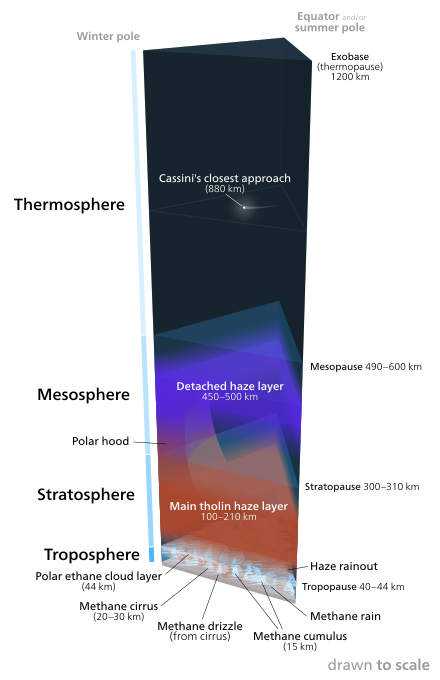
I find the following image to be quite interesting as it shows the layers of Titan's atmosphere.
The image below shows polar clouds on Titan (left) compared with polar clouds on Earth (right). I particularly liked the colours in these clouds, it looks very alien for something we see on our planet everyday.
That should hopefully be the last science-based post and I'd now like to look at how alien and hostile environments are created in movies to tell a narrative or convey the danger of the environment.
As part of the coursework submissions I have built a more detailed plan for what I'd like to create this semester.
I have chosen to focus on environmental dynamic effects, in particular atmospheric effects, clouds and dust. I'll be looking into the way fluids and particles can be used to create these effects and how they can be used to inform the viewer the narrative of the environment.
Research has already been posted to this blog but I'd like to also look into films as an example. I referenced Prometheus and Riddick as examples of alien planets that have a hostile feel to them.
I've set myself the following aims:
To explore and understand the use of dynamic fluids and particles in the creation of atmospheres, clouds and dust.
Explore how atmospheric and environmental VFX can be used to enhance the narrative in film or animation.
Create a series of renders that reflect the research and testing.
The tasks I've set myself for the project include creating iterations of simulations with maya fluids and particles, research into VFX environments in films, and finally putting what I've learned together into a final scene or scenes.
As a lot of this is new to me I've not entirely defined the scope as to what I'll be able to cover but I will definitely have a final rendered shot as well as progress and iterations playblasts.
The full learning contract document can be viewed on Dropbox.
Last semester I looked into the job of a Technical Artist, I thought it would only be fair to research into the role of a visual effects artist, particularly focusing on environments and effects similar to the ones I'm looking to create.
The career of a visual effects artist is reasonably well known as it they are often known for long working hours when it comes to meeting deadlines. There are also many smaller studios which take on freelance VFX artists and employ their own. Multiple visual effects studios might often be hired to work on the same film at one time.
There are a huge number of visual effects breakdowns, but this video containing work from Marco Lozzi was very interesting to see the wide variety of the types of shots a VFX artist might work on. I was often pleasantly surprised to see the number of real life locations that included CGI composited into the background.
A huge part of VFX particularly in environments is trying to keep the additions consistent with both lighting but also texture. With the advent of High Definition movies, there were a good few years during the early 2000s where CGI was very noticeable because it stood out from surrounding textures. A good VFX artist understands and aims to try and keep the consistency between the CGI and live action shots.
Lastly, the idea I wanted to research into was the atmospheric re-entry effects. There's a great satisfaction while playing Kerbal Space Program to de-orbit spacecraft and watch them heat up and fall apart as they enter. In reality, things work pretty much the same, anything going fast entering the Earth's atmosphere won't stand a chance without shielding.
I recently followed NASA as they launched their new Orion spacecraft into orbit to test the high speed re-entry as it entered the atmosphere. This was the first time I'd seen the re-entry process filmed from inside the spacecraft and broadcast live (minus a small blackout due to plasma). The re-entry effects are fiery but not your traditional fire, a very high intensity concentration of flames.
A big movie from 2013 was Gravity, probably the best interpretation of realistic (well as close as you can get) spaceflight. In the movie [Spoiler] astronaut Sandra Bullock finds herself in the de-orbiting Tiangong Space Station. The space station goes through several stages as it falls, first from shaking to breaking apart, air streaks and finally fully breaking apart and immense heat.
While probably not realistically accurate (although still highly accurate), cinematically it did the job as intended, creating a very dramatic finale to the movie.
I may also want to consider the break up of asteroids, there are lots of amateur footage of asteroids falling to Earth, notably a meteor that exploded over Russia in 2013.
Along the lines of asteroids and comets, we got the best views of a comet in 2014 with Rosetta's visit to 67P/Churyumov-Gerisamenko. Some of the pictures it has returned have been fascinating and as the comets gets closer to the sun we can see the gas and dust outflows become much more active. Although these are stills, it'd be interesting to explore generating these effects in Maya, emulating it realistically while also exaggerating it for artistic effect, giving the viewer a feel of what it may be like on the comet.
I've looked at planetary bodies and atmospheric effects, another idea was to go closer in and explore the creation of a ground level scene of an alien planet or hostile, out-of-the-way environment. The project would be slightly more focused on expressing how that scene feels. If you were to place yourself at the scene I'd want to create the necessary particles and atmosphere to say the following things:
How hot or cold it is - using embers or snowflakes
How thick the atmosphere is or the feeling of high air pressure - by creating fog volumes
How hostile the environment is - nature of the particles, speed of the wind, use of colour
Many sci-fi films use these visual techniques very well, some will use most or all of them and others will put them aside for more emphasis on the contents or character of the environment. As this would be a visual effects project I'd want to concern myself more with the fluids and particles side of the scene.
I re-looked at some films which build an environment scene with the elements I am researching. One example is from Prometheus. I was most impressed at the initial landing scene where the planet is introduced. The cloud levels vary all over from very high clouds to middle level storm clouds and ever looming ground fog. It sets the scene as being a very different place from earth and all the elements together do point to a different atmosphere but not so different to be deadly. I found a nice visual effects breakdown which does have more compositing elements but is useful:
One of my all time favourite movie franchises is The Chronicles of Riddick, in each movie a different planet is visited, each with its own unique feature. In The Chronicles Riddick (second movie) there is a planet which is very close to its sun which turns daytime hours into flaming no-go zone. Although a little dated there are some neat things in the scene, the way the air mirages with the heat and the steam are enough to tell us its hot. The wall of fireballs is a bit gimmicky but awesome to watch.
Interstellar is the latest big sci-fi movie so I feel obliged to give it a mention. Interstellar visits a few planets with one being an icy lifeless planet. I think its done very well, the clouds are very calm and cover the sky leaving it a white scene. There is a constant light snowfall which says it all. I was particularly interested in the way the blizzard seems to hover over the planets surface which I think is also partly a release of ice from the surface.
I'd also like to give Avatar an honourable mention, you'd think the planet of Pandora would come to mind for a project like this but it doesn't particularly cover what I am exploring. What Pandora does great is the content of the environment (the plantlife, the floating mountains, the terrain) but doesn't particularly focus on the elements I want to explore. It does do a very good job of the clouds, there are a lot of fine light mist-like clouds which really emphasise how "airy" the air was, hinting at a more fuller and dense atmosphere.
The following tutorials demonstrate some of the effects I may want to explore with for this type of scene:
An idea that I may want to explore is that of planetary bodies, atmospheric particles and effects. A classic example of this is the Star Trek (2009) credits where a whole number of different planet concepts are shown. Each scene is very dramatic, often with multiple close-by planets in varying sizes and colours. Also shown are cosmic dust clouds, broken planets, asteroid fields and collisions and J.J. Abrams' signature lens flares (yeah maybe a bit too many of them).
What I was originally thinking was to explore and produce the atmospheric effects surrounding the planets but was thinking of how I'd make a project out of that. Typically these effects are simply just glows around a sphere but in the Star Trek credits there is much more, with geysers and jets of gas or material coming off some planets. There are also a number of asteroid fields and some smashed up planets which may also add some depth to scenes I might want to make.
I looked into a few ways of how these effects are achieved and came across the following tutorials. In the first tutorial an atmosphere is created using a fluid container, part of the maya dynamics system which would be a good area to explore. A colour ramp is used to get the desired effect. One step to go further could be to add dynamic clouds, winds or fog. This would be more suited to a rendered image or preferably a video if I were to turn this into a project.
A dynamic cloud layer like the one in this tutorial could be a start in adding more depth to an atmosphere scene. Scripting could be used to program the behaviour of winds and how those clouds moved. Note that both these tutorials are closer to the planet and not dealing with a spherical volume.
My aim of the project would be to assist in telling the narrative of a scene. How a planet looks like from this angle can tell of the hostility or nature of the planet: the colours and thickness of the atmosphere, how active clouds and particles move within it, the types of particles in the atmosphere (dust, embers, moisture, etc.)
I have taken Scripting & Dynamics this semester which is a continuation of the Technical Art Applications module.
For the coursework we are able to choose a project in any of the many fields of visual effects and scripting for visual effects. I am more particularly interested in the art side of the course and how I could use particle systems and dynamics to help build an environment.
Although we've yet to look at the particular methods of fluids, cloth and scripting, I can begin to think about what kind of things I may want to make:
Planetary and space visual effects
Atmospheric effects including particles, weather, winds, smoke, etc.
Compositing effects onto film
Meteor or spacecraft re-entry effects
I am interested in exploring anything related to space as I feel my personal interest and knowledge of astronomy and spaceflight could be used to my advantage.